Apulia
From EpiMedDat
In Apulia, a total of 10 epidemic events are known so far. It is a region.
Map of events in Apulia
Table
| Disease | DateStart date of the disease. | SummarySummary of the disease event | OriginalOriginal text | TranslationEnglish translation of the text | ReferenceReference(s) to literature | Reference translationReference(s) to the translation |
|---|---|---|---|---|---|---|
| 1316-00-00-Northwest-Europe | 1316 JL | Great Famine in Northwest-Europe, therefore grain export from southern Italy; epidemic also in Italy | Nel detto anno MCCXVI grande pestilenzia di fame e mortalità avenne nelle parti di Germania, cioè nelle Magna di sopra verso tramontana, e stesesi in Olanda, e in Frisia, e in Silanda, e in Brabante, e in Fiandra, e in Analdo, e infino ne la Borgogna, e in parte di Francia; e fu sì pericolosa, che più che il terzo de la gente morirono, e da l'uno giorno a l'altro quegli che parea sano era morto. E 'l caro fu sì grande di tutte vittuaglie e di vino, che se non fosse che di Cicilia e di Puglia vi si mandò per mare gli mercantati per lo grande guadagno, tutti morieno di fame. Questa pestilenzia avenne per lo verno dinanzi, e poi la primavera e tutta la state fu sì forte piovosa, e 'l paese è basso, che l'acqua soperchiò e guastò ogni semanta. Allora le terre affogarono sì, che più anni appresso quasi non fruttarono, e corruppe l'aria. E dissono certi astrolaghi che la cometa ch'apparve, ch'ella dovea venire perché la sua infruenzia fu sopra quegli paesi. E in quello tempo la detta pestilenzia contenne simigliamente i Romagna e in Casentino infino in Mugello. | In the said year (1316) there was a great plague of famine and death in the parts of Germany, that is, in Magna above towards the north, and it spread to Holland, and to Friesland, and to Silesia, and to Brabant, and to Flanders, and to Analde, and even to Burgundy, and to parts of France; and it was so dangerous that more than a third of the people died, and from one day to the next those who seemed healthy were dead. And the cost was so great of all the victuals and wine, that if it were not for the fact that the merchants of Cicilia and Apulia were sent there by sea for the great profit, all died of hunger. This pestilence happened during the winter before, and then the spring and the whole state was so rainy, and the land was so low, that the water overpowered and spoiled every seed. Then the land drowned so, that more years after it scarcely bore fruit, and corrupted the air. And certain astrologers said that the comet that appeared, that it had to come because its infuence was over those countries. And at that time the said pestilence similarly contained the Romagna and Casentino until Mugello. | Template:Giovanni Villani 1990, vol. 2: p. 285 | Translation by DeepL |
| 1346-00-00-Europe | 1346 JL | This passage describes the spread of the plague beginning in Jerusalem and than moving forward across Europe. The jews were blamed for causing the plague by poisoning the people. | 653. Des sulven jares unstund de grote plaghe der mynsheit des (p. 505) ghaen dodes, erst in den Jhersualemeschen landen over mer unde in der heidenscap, de by veftich, sestich, hundert, dusent unde ane tal nedervellen unde waren dot. dat stund nicht sere to claghen, wente se Godes viande sint; mer de sulve grote plaghe quam seder in cristene land. erst wart se vornomen in Pulle, dar na in Ungharen, dar na in Cecilien, in Avignon, dar neghest to Marsilien, dar na in Brancriken, dar na Engheland, dar vele lude storven; dar na in Blanderen, van Blanderen in Norweghen, dar na in Sweden, van Sweden in Denemarken, in Nortjutlande unde uppe Selande, dar na in Prutzen. to Koninghesberch, to Melbinghen was grot sterven. des tech men den ghedosten joden, de sik vor cristene lude helden unde beden dor Got ghuder lude almusen, dat de mit vorghifnisse, de se den luden gheven, dat volk to deme dode brochten. Dat wart van en gheseen unde worden anghetastet unde worden ghebrand; do bekanden se in erme dode, dat it war were, dat se it hadden ghedan, unde dat ir vele were, de in der selven sake in der cristenheit ghinghen, unde segheden, dat de riken joden in den groten steden dat bedacht hedden der cristenheit to vorderfnisse, wente se sint der martere unses heren ghevanghen lude hebben wesen, unde wolden nu koninghe unde heren worden sin over al den cristendom. | 653. In the same year (1346), the great plague of humanity, the walking death, began, first in the lands of Jerusalem, across the sea and among the pagans, where fifty, sixty, a hundred, a thousand, and countless people fell and died. This was not much mourned, as they were considered enemies of God. However, this same great plague later came into Christian lands. First, it was observed in Apulia, then in Hungary, then in Sicily, in Avignon, then near Marseille, then in (...?), and then in England, where many people died; next, in Flanders, from Flanders to Norway, then to Sweden, from Sweden to Denmark, in North Jutland and on Zealand, then to Prussia. In Königsberg and Melbingen, there was great mortality. The Jewish converts, who presented themselves as Christian and begged for alms in the name of God, were blamed for bringing the death to the people with giving them poison. They were discovered and persecuted, and many were burned. Under torture, they confessed that it was true—that they had done it, and that many of them across Christendom were involved in this crime. They claimed that the wealthy Jews in large cities had devised this plot to destroy Christianity, as they had long been captives since the martyrdom of our Lord and now wanted to become kings and rulers over all Christendom. | Detmar's Croneke van Lubeke 1884/99, Vol. 1, pp. 504-505. | Translation by ChatGPT-3.5 |
| 1347-00-00-Naples | 1347 JL | Louis I of Hungary went on pilgrimage to Apulia to confirm the barons and to escape the plague which already raged in Naples. | […] E partita del Regno la detta compagna, se n'andò il re il Puglia in pellegrinaggio al Monte Santo Agnolo e San Nicolò di Bari, e per sagire i baroni e paese di Puglia alla sua signoria, e per cessare la pistolenza della mortalità, che già era cominciata a Napoli grandissima. | After this company departed the regno, the king went on pilgrimage to Puglia, to Monte Santo Angelo and San Niccolò di Bari, to confirm the barons and the land of Puglia under his lordship and to escape the pestilence of sickness which had already begun and was already great in Naples. | Giovanni Villani 1990, Vol. 3, p. 548. | None |
| 1347-11-00-Italy | November 1347 JL | Arrival of the Black Death in Genoa and spread across Italy; but Parma and Milan remain almost untouched | Nelle parti oltra mora per più sei mesi fu grandissima pestilenza, la quale dalle galee de' Genovesi fu portata in Italia; e furono a Genova ricevute del mese di Novembre le prefate galee, sulle quali, prima che arivassero a Genova, era morta di questa mala influenza la maggior parte di coloro, che vi erano sopra: il rimanente morì quasi subito che furono in Porto e patria loro, questa infermità si allargò nella Citta, & infiniti ne morivano il giorno, & in breve per ogni Città di Lombardia, di Toscana, della Marca, della Puglia, e per ogni terra d'Italia si estese. E fu grandissima due anni continui, per la quale molte Città d'Italia furono distrutte; e sole Parma, e Milano pochissimo ne senterono; ma si sparse oltra monti, in Provenza, in Francia, in Aragona, in Spagna, in Anglia, in Alemagna, in Boemia, in Ungheria. | In the parts beyond the sea, for more than six months, there was a great pestilence, which was brought to Italy by the Genoese galleys; and in November, the aforementioned galleys were received in Genoa, on which, before they arrived in Genoa, the majority of those on board had died from this bad influence: the rest died almost immediately upon reaching their port and homeland. This disease spread in the city, and countless people died each day, and soon it extended to every city in Lombardy, Tuscany, the Marches, Apulia, and throughout all of Italy. It was exceedingly severe for two continuous years, during which many cities in Italy were destroyed; only Parma and Milan felt it very little; but it spread beyond the mountains, into Provence, France, Aragon, Spain, England, Germany, Bohemia, and Hungary | Giovanni di Cornazano 1728, col. 746 | Translation by Martin Bauch |
| 1347-11-00-Italy1 | November 1347 JL | Societal consequences of the Black Death across Italy | anzi tutto il Mondo sì Cristiani, com Infedeli ne furono infetti, e furono da servi, da' Medici, da' Notari, da' Preti, e Frati, abbandonati gl' Infermi, tal che non erano serviti nè curati, nè potevano testare, nè confessi o contriti assoluti morire i miseri Apestati. La cagione di ciò era, che subito che s'apressavano a gl'Infermi, cadevano in cotale disavventurata peste, e morivano per lo più di subito, tanto che molti insepolti restavano, e l'uno, e l'altro abbandonato laiciava, nè conoscevasi che Padre avesse Figluoli, nè Moglie Marito, nè Amico compagno, e quantunque molti ricchi morissero, non erano allora pronti gli heredi a cercare i posessi dell facultadi; anzi senza prezzo era tutta la richezza tenuta; nè più si conosceva gli avari avere l'oro più che la vita caro. Cosa horribile a vedere, che gli huomini abbandonando gli huomini, gli odi, le invidie, le lascive, le facoltà, l'amore terreno, tutti volti in timore d'horrida e spaventevole morte. | The whole world, both Christians and infidels, were infected, and the sick were abandoned by servants, doctors, notaries, priests, and friars, so that they were neither served nor cared for, nor could they make a will, nor die confessed or absolved, the miserable plague victims. The reason for this was that as soon as they approached the sick, they fell into such unfortunate pestilence and died almost immediately, so that many remained unburied, and one and the other abandoned each other, and it was not known that a father had children, nor a wife a husband, nor a friend a companion. And although many rich people died, the heirs were not then ready to seek their possessions; rather, all wealth was held without value, and it was no longer known that the avaricious held gold dearer than life. It was horrible to see that humans, abandoning humans, hatreds, envies, lusts, possessions, and earthly love, all turned to fear of a horrible and frightening death | Giovanni di Cornazano 1728, col. 746 | Translation by Martin Bauch |
| 1348-00-00-Apulia | 1348 JL | The Black Death hits Apulia and other parts of Southern Italy like Calabria. King Louis the Great of Hungary flees back home from the epidemic outbreak | sequitur annus qui nostre salutis MCCCXLVIII numeratur, in quo pestis iam pridem cepta insigni strage per universam pene Italiam desevire cepit. Que, cum iam Brutios et Calabros ac universum Apulie Regnum inficere cepisset, et in dies magis obrepert, tantaque augmenteratur sevitia, ut solo contactu passim vulgaret morbos, et tabe ac pestifero odore inficeret validos, et egros biduo aut minori temporis spatio (p. 12) conficeret, ingens mortis formido Ludovicum, Ungarie regem, invasit, qua deterritus in Pannoniam aufugere quam celerrime constituit. | There follows the year which is numbered 1348 of our salvation, in which the plague, already begun some time before, began to rage with remarkable slaughter throughout almost the whole of Italy. And when it had already begun to infect the Calabrians and the entire Kingdom of Apulia, and was spreading more and more each day, and was increasing with such savagery that by mere contact it widely transmitted diseases, and by corruption and pestilential stench infected even the healthy, and carried off the sick within two days or a shorter space of time, a great fear of death seized Louis, king of Hungary; terrified by this, he resolved to flee as quickly as possible into Pannonia. | Matteo Palmieri 1918, pp. 11-12 | Martin Bauch / ChatGPT 5.2 |
| 1348-00-00-Apulia 001 | 1348 JL | King of Hungary left Apulia because of the plague and Joanna, wife of Duke Louis of Taranto returned to Naples and resubdued the country. | 112.) Qualiter rex Ungarie recessit ab Apulia propter pestilenciam. Reverso autem propter pestilenciam Ungaro Iohanna relicta Andree fratris sui uxor de auxilio pape Neapolim revertitur, et eiectis Ungari fidelibus terra sibi iterum subiugatur, Wernhero de Urselingen Swevo, qui primo Ungaro adhesit et ab eo propter quandam suspicionem sibi falso impictam, ut dixit, licenciatus fuit, eidem Iohanne propter pecuniam assistente. Tribunus enim Urbis, fautor Ungari, disparens eo tempore non erat potens in Urbe. Vendidit autem ipsa Iohanna, quantum in ea fuit pape civitatem Avinionensem pro multa pecunie quantitate. | 113.) How the King of Hungary left Apulia because of the plague. After the Hungarian had gone home on account of the prevailing plague, Joanna, the widow of his brother Andrew and wife of Duke Louis of Taranto, returned to Naples with the help of the pope, expelled the followers of the Hungarian, and resubdued the country, being assisted for money by Werner of Urslingen, a Swabian, who had formerly served the Hungarian (p. 171), but had been dismissed by him on account of what he said was an unjust suspicion. The tribune of Rome, the supporter of the Hungarian, had disappeared around this time and no longer had any power in Rome. Queen Joan, however, sold the city of Avignon to the pope for a large sum of money. | Matthias de Nuwenburg Chronica 1924-40, p. 262 | None |
| 1358-05-00-Orvieto | May 1358 JL | Outbreak of the Pestis secunda in Orvieto, more than 5000 deaths. | De l'anno mille et trecento cinquanta otto del mese di magio si cominciò in Orvieto grandissima mortalità di gente, et del mese di giugno et di luglio sequente sempre venne rinforzanno la mortalità finente il mese di agosto, sì che in Orvieto morì in questo anno molta gente, spetialmente cituli et giovani et giovane, che pochi giacavano amalati. Sí che si trovò in Orvieto, dentro alla città, morirno in questi quattro mesi, infra maschi et femine et grandi et piccholi, più di cinque milia persone, infra li quali morirno assai buoni cittadini notevoli et boni homini. Onde che la città di Orvieto ricevette grandissimo danno di boni cittadini. | In May of 1358 a great mortality of people began in Orvieto, and from the following months of June and July, the mortality rate always increased until the end of the month of August, so that in this year many people died in Orvieto, especially young men and women and young men and women, who were only a few sick. So that in Orvieto, inside the city, more than five thousand people died in these four months, including males and females, young and old, among whom many notable good citizens and good men died, so that the city of Orvieto received great damage from good citizens. | Anonymus 1922-24, p. 84 | Translation by DeepL |
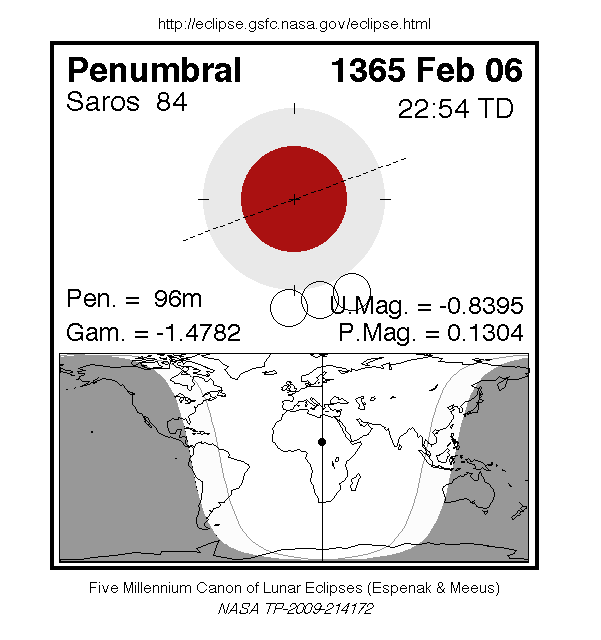
| 1365-02-00-Apulia | February 1365 JL | A lunar eclipse on 8th of February (actually 6th) predicts cold and wind; almost all people fall ill with fever and cough, affects wide regions like Apulia, Bologna, Marche, Tuscia and Lombardy | Ancora, adì 8 de febraro, la nocte vegnando, la luna divenne tucta sanguinea per assai volte, et ancho si mostrò schura, zoè negra; et durò per spazio d'uno quarto d'una ora o più. Et per questo accidente, a quisti dì, si fu uno fiero et forte tempo, cum grandi venti et grande zelo: et si fu una sì fiera pestilenza de fredo nelle persone de' christiani, cum grande febre et tosse et male assai; et si n'è stadi de morti alchuna parte per questa malatia, et si se pò dire che non rimase nessuno, generalmente, che non sentisse la malatia. Et questo fu per tucte le parte, zoè in la Puglia et in la Marcha, in Thoscana, in Romagna, in Lombardia, et generalmente per tucto; et questo comminzò de febraro et durò di fine al mese marzo, che fu chossì grande et forte tempo et grande malatia | Again, on 8 February, when the night was coming, the moon became completely bloody for many times, and it also became dark, that is, black; and it lasted for a quarter of an hour or more. And for this reason, on this day, there was a fierce and strong weather, with great winds and great zeal: and there was such a fierce plague of cold in the people of the Christians, with great fever and coughing and much evil; and there were many deaths from this disease, and it can be said that there was no one left, in general, who did not feel the sickness. [...] | Template:Anonymus 1938b, p. 211 | None |
| 1370-00-00-Florence | 1370 JL | Due to the bad weather in the previous year, there was a great famine in Florence. This was fuelled by wars in Italy and a mortality of cattle, which is why no livestock came to Florence. | Rubrica 723a - Come' in questo anno fu grande carestia d'ogni cosa. Nel detto anno [1370] fu grandissima carestia, perocchè per la gran pioggia dell'anno passato, e perchè era stata guerra, non s'era raccolto assai abbastanza; di che convenne si mandasse per grano di fuori. E valse quell'anno lo staio fiorentino, tre mesi: ciò fu febbraio, marzo e aprile e parte di maggio, un fiorino lo staio. E quel medesimo anno di vino fu gran carestia, perocchè valse fiorini uno la barile di ricolta, e di state fiorini uno e mezzo il barile. Ancora fu carestia di carne, perocchè quell'anno era stata in Lombardia la guerra e in Toscana e in molte luogora, per la quale cagione non era venuto a Firenze bestiame di Puglia, donde ne solea venire assai. Quell'anno v'ebbe mortalità di bestiame, la qual cosa gittò assai carestia oltre all'altre cagioni di sopra narrate. | Rubrica 723a - How in that year there was a great famine of everything. In the year in question [1370] there was a great famine because not enough grain had been harvested due to the heavy rains of the previous year and the war, so grain had to be brought in from outside. In the months of February, March, April and partly in May, a staio of Florentine grain cost one florin. In the same year there was a great shortage of wine, as a barrel of wine cost one florin and in summer one and a half florins. There was also a shortage of meat, because in that year there was war in Lombardy and Tuscany and in many other places, which is why no cattle came to Florence from Apulia, where they often came from in the past. In that year there was a great death of cattle which, in addition to the other reasons mentioned above, caused a great famine. | Marchionne di Coppo Stefani 1903, p. 275 | Translation by ChatGPT-3.5; Translation by DeepL; |