Marche
From EpiMedDat
In Marche, a total of 4 epidemic events are known so far. It is a region.
Map of events in Marche
Table
| Disease | DateStart date of the disease. | SummarySummary of the disease event | OriginalOriginal text | TranslationEnglish translation of the text | ReferenceReference(s) to literature | Reference translationReference(s) to the translation |
|---|---|---|---|---|---|---|
| 1347-11-00-Italy | November 1347 JL | Arrival of the Black Death in Genoa and spread across Italy; but Parma and Milan remain almost untouched | Nelle parti oltra mora per più sei mesi fu grandissima pestilenza, la quale dalle galee de' Genovesi fu portata in Italia; e furono a Genova ricevute del mese di Novembre le prefate galee, sulle quali, prima che arivassero a Genova, era morta di questa mala influenza la maggior parte di coloro, che vi erano sopra: il rimanente morì quasi subito che furono in Porto e patria loro, questa infermità si allargò nella Citta, & infiniti ne morivano il giorno, & in breve per ogni Città di Lombardia, di Toscana, della Marca, della Puglia, e per ogni terra d'Italia si estese. E fu grandissima due anni continui, per la quale molte Città d'Italia furono distrutte; e sole Parma, e Milano pochissimo ne senterono; ma si sparse oltra monti, in Provenza, in Francia, in Aragona, in Spagna, in Anglia, in Alemagna, in Boemia, in Ungheria. | In the parts beyond the sea, for more than six months, there was a great pestilence, which was brought to Italy by the Genoese galleys; and in November, the aforementioned galleys were received in Genoa, on which, before they arrived in Genoa, the majority of those on board had died from this bad influence: the rest died almost immediately upon reaching their port and homeland. This disease spread in the city, and countless people died each day, and soon it extended to every city in Lombardy, Tuscany, the Marches, Apulia, and throughout all of Italy. It was exceedingly severe for two continuous years, during which many cities in Italy were destroyed; only Parma and Milan felt it very little; but it spread beyond the mountains, into Provence, France, Aragon, Spain, England, Germany, Bohemia, and Hungary | Giovanni di Cornazano 1728, col. 746 | Translation by Martin Bauch |
| 1347-11-00-Italy1 | November 1347 JL | Societal consequences of the Black Death across Italy | anzi tutto il Mondo sì Cristiani, com Infedeli ne furono infetti, e furono da servi, da' Medici, da' Notari, da' Preti, e Frati, abbandonati gl' Infermi, tal che non erano serviti nè curati, nè potevano testare, nè confessi o contriti assoluti morire i miseri Apestati. La cagione di ciò era, che subito che s'apressavano a gl'Infermi, cadevano in cotale disavventurata peste, e morivano per lo più di subito, tanto che molti insepolti restavano, e l'uno, e l'altro abbandonato laiciava, nè conoscevasi che Padre avesse Figluoli, nè Moglie Marito, nè Amico compagno, e quantunque molti ricchi morissero, non erano allora pronti gli heredi a cercare i posessi dell facultadi; anzi senza prezzo era tutta la richezza tenuta; nè più si conosceva gli avari avere l'oro più che la vita caro. Cosa horribile a vedere, che gli huomini abbandonando gli huomini, gli odi, le invidie, le lascive, le facoltà, l'amore terreno, tutti volti in timore d'horrida e spaventevole morte. | The whole world, both Christians and infidels, were infected, and the sick were abandoned by servants, doctors, notaries, priests, and friars, so that they were neither served nor cared for, nor could they make a will, nor die confessed or absolved, the miserable plague victims. The reason for this was that as soon as they approached the sick, they fell into such unfortunate pestilence and died almost immediately, so that many remained unburied, and one and the other abandoned each other, and it was not known that a father had children, nor a wife a husband, nor a friend a companion. And although many rich people died, the heirs were not then ready to seek their possessions; rather, all wealth was held without value, and it was no longer known that the avaricious held gold dearer than life. It was horrible to see that humans, abandoning humans, hatreds, envies, lusts, possessions, and earthly love, all turned to fear of a horrible and frightening death | Giovanni di Cornazano 1728, col. 746 | Translation by Martin Bauch |
| 1360-00-00-Europe | April 1360 JL | The passage describes the way in which the plague spread, beginning in England in April and May and then spread to France, Lombardy, Romagne, Marche and Majorca. Matteo Villani criticised the persistence of people in their sins and the forgetting of the Judgement Day. | Della pistolenzia dell'anguinaia ricominciata in diversi paesi del mondo, e di sua operazione. In Inghilterra d'aprile e di maggio si cominciò, e seguitò di giugno e più inanzi, la pistolenzia dell'anguinaia usata, e ffuvi tale e tanta, che nella città di Londra il dì di san Giovanni e 'l seguente morirono più di MCC Cristiani, e in prima e poi per tutta l'isola. Gran fracasso fece per simile ne reame di Francia: nella Proenza trafisse ogni maniera di gente. Vignone corruppe in forma che no vi campava persona: morironvi nove cardinali, e più di VIIC plelati e gran cherici, e popolo inumerabile. E di maggio e giugno si stese e percosse la Lombardia, e prima Commo e Pavia, co tanta roina, che quais le recò in desolazione. In Milano misse il capo, dove altra volta nonn-era stata, e tirò a terra il popolo quasi affatto, con grande orrore e spavento di chi rimanea. Vinegia toccò in più riprese, e tolsele oltre a XXM viventi. La Romagna opressò forte e assai quasi per tutte sue terre, ma ppiù l'una che l'altra, e nell'entrata del verno cominciò a restare i Lombardia, e a gravare la Marca, e lla città d'Agobbio forte premette. L'isola della Maiolica perdé oltre alle tre parti de li abitanti. Né lasciò l'alpi delli Ubaldini sanza macolo per molti de' (p. 514) luoghi suoi. E molti paesi del mondo inn-uno tempo erano di questo pistolenzia corrotti, né già quelli a ccui parea che Dio perdonasse no ritornavano a llui per contrizione, partendosi dalle iniquitadi e dalle prave operazioni ostinate, e come le bestie del macello, veggendo l'altre nelle mani del beccaio col coltello svenare, saltavano liete nella pastura, quasi come a lloro non dovesse toccare, ma più dimenticando li uomini il giudicio divino si davano sfacciatamente alle rapine, alle guerre, e al mantenere compagne contra ogni uomo, alle ingiurie de' prossimi, e alle disoluta vita, e a' mali guadagni assai più che nelli altri tempi, corompendo la speranza della misericordia di Dio per lo male ingegno delle perverse menti; e cciò per manifesta sperienza si vide in tutte le parti del mondo dove la detta pistolenzia mostrò il giudicio di Dio. | On the resurgence of the plague of the groin in various countries of the world and its effects In England, the familiar plague of the abdomen began in April and May and continued through June and beyond. It was so devastating that on St John's Day and the following day, more than 1200 Christians died in the city of London, as well as before and after throughout the island. The plague caused similar chaos in the Kingdom of France; in Provence it affected people of all kinds. In Avignon, it raged so strongly that no one there was spared: nine cardinals died, over 700 prelates and great clerics as well as countless people from the populace. In May and June, it spread to Lombardy, first to Como and Pavia, causing such destruction that these cities were almost depopulated. In Milan, where it had not been before, it caused great damage and decimated almost the entire population, causing great fear and terror among the survivors. Venice was hit in several waves and lost over 20,000 people. Romagna was hit hard, almost all towns were affected, some more than others. At the end of the winter, the plague began to subside in Lombardy, while it hit the Marche hard and put the city of Gubbio under severe pressure. On the island of Majorca, over three quarters of the population died. Even the Alps of the Ubaldini were not spared, and many of their towns were badly hit. At the same time, many countries of the world were afflicted by this plague, and those who believed that God had mercy on them did not return to him through repentance, but persisted in their sins and evil deeds. Like cattle for the slaughter, seeing their fellow animals in the hands of the butcher with a knife, they jumped happily to the pasture as if they would not be hit. But people, forgetting divine judgement, shamelessly indulged in robbery, wars and maintaining gangs against everyone, committing injustice against their neighbours, living a dissolute life and seeking ill-gotten gains, far more than at other times. This corrupted the hope of God's mercy by the evil nature of their perverse minds; and this could be observed in all parts of the world, where the aforementioned plague showed the judgement of God. | Matteo Villani 1995, vol. 2, pp. 514-515. | Translation by ChatGPT-3.5; Translation by DeepL; |
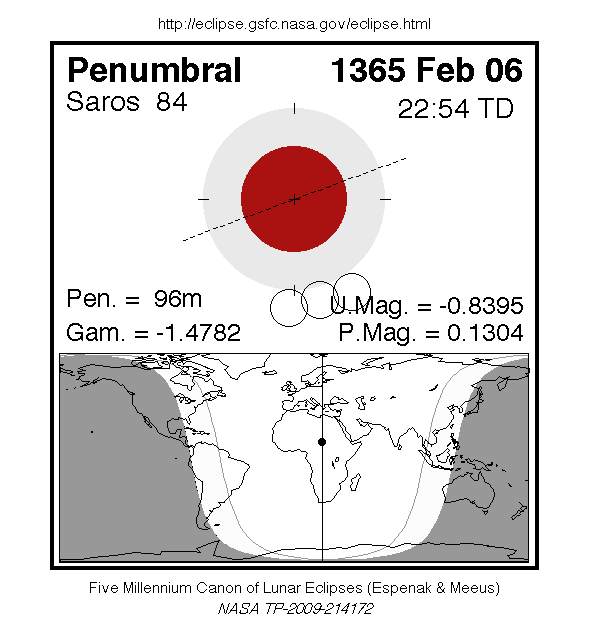
| 1365-02-00-Apulia | February 1365 JL | A lunar eclipse on 8th of February (actually 6th) predicts cold and wind; almost all people fall ill with fever and cough, affects wide regions like Apulia, Bologna, Marche, Tuscia and Lombardy | Ancora, adì 8 de febraro, la nocte vegnando, la luna divenne tucta sanguinea per assai volte, et ancho si mostrò schura, zoè negra; et durò per spazio d'uno quarto d'una ora o più. Et per questo accidente, a quisti dì, si fu uno fiero et forte tempo, cum grandi venti et grande zelo: et si fu una sì fiera pestilenza de fredo nelle persone de' christiani, cum grande febre et tosse et male assai; et si n'è stadi de morti alchuna parte per questa malatia, et si se pò dire che non rimase nessuno, generalmente, che non sentisse la malatia. Et questo fu per tucte le parte, zoè in la Puglia et in la Marcha, in Thoscana, in Romagna, in Lombardia, et generalmente per tucto; et questo comminzò de febraro et durò di fine al mese marzo, che fu chossì grande et forte tempo et grande malatia | Again, on 8 February, when the night was coming, the moon became completely bloody for many times, and it also became dark, that is, black; and it lasted for a quarter of an hour or more. And for this reason, on this day, there was a fierce and strong weather, with great winds and great zeal: and there was such a fierce plague of cold in the people of the Christians, with great fever and coughing and much evil; and there were many deaths from this disease, and it can be said that there was no one left, in general, who did not feel the sickness. [...] | Template:Anonymus 1938b, p. 211 | None |